Navigating the global hosiery supply chain requires more than just an understanding of denier counts and yarn compositions. For brand owners, retail buyers, and importers, the foundational decision that dictates cost, speed to market, and intellectual property rights is the manufacturing model chosen: OEM, ODM, or Private Label. In the hosiery industry—specifically within the specialized knitting hubs of Jinhua, Zhejiang—these terms are frequently used but often misunderstood.
Choosing the wrong model can lead to significant friction. A startup brand might find itself overwhelmed by the technical demands of a full OEM brief, while a luxury boutique might find the lack of exclusivity in a private label arrangement damaging to its brand equity. Understanding the nuances of these three pillars is essential for any professional sourcing strategy in the tights and legwear sector.
Defining the Three Pillars of Hosiery Manufacturing
Before comparing the merits of each, it is necessary to establish precise definitions for the three primary engagement models. These models represent a spectrum of control and responsibility shared between the buyer and the manufacturer.
OEM (Original Equipment Manufacturing)
In the OEM model, the buyer provides the technical specifications, designs, and often the exact knitting patterns. The factory functions as a specialized production arm. You are not buying a product the factory already makes; you are hiring their machinery, labor, and technical expertise to bring your unique vision to life. This is the "make-to-print" model. If you have a proprietary knitting technique or a unique aesthetic design that does not exist in the market, OEM is your path.
ODM (Original Design Manufacturing)
ODM involves the factory taking the lead on product development. The manufacturer designs and develops the product, often maintaining a library of existing styles that have already been tested for fit, durability, and market appeal. The buyer selects an existing design and rebrands it. This is the "make-to-sample" model. While the manufacturer owns the underlying design, the buyer owns the brand identity applied to it.
Private Label
Private labeling is often the fastest entry point into the market. In this model, the buyer selects a finished product from the factory’s catalog and applies their own branding, tags, and packaging. The design ownership remains firmly with the factory, and the same product may be sold to multiple buyers under different labels. It is an "off-the-shelf" branding solution that prioritizes convenience and speed over design exclusivity.
The Comparison Matrix: OEM vs. ODM vs. Private Label
| Feature | OEM (Original Equipment) | ODM (Original Design) | Private Label |
|---|---|---|---|
| Design Ownership | Buyer | Factory | Factory |
| Tooling & IP Ownership | Buyer | Factory | Factory |
| Specification Control | Total / Granular | High (Modification) | Low (Packaging Only) |
| Minimum Order Profile | Higher | Moderate | Lower |
| Lead Time Profile | Long (Development + Prod) | Moderate | Short |
| Development Cost | High (Prototyping/Sampling) | Low | Zero |
| Speed to Market | Slow | Moderate | Fast |
| Best Suited For | Established Brands / Innovators | Scaling Retailers | Startups / Flash Sales |
The OEM Deep Dive: Total Control and Technical Rigor
For a brand focusing on technical innovation—such as a new compression profile or a unique patterned lace—OEM is the only viable route. However, this model requires the buyer to possess significant technical hosiery knowledge. When you commission an OEM order, you are responsible for the technical specification document, commonly known as a tech pack.
In the context of high-performance hosiery, such as plus size tights, the OEM model allows for specific adjustments to the knitting tension in the thigh and waistband areas. This level of customization ensures that the final product meets exact ergonomic requirements that generic designs might ignore.
The primary risk in OEM is the "development loop." Because the factory is building a new product from your specifications, multiple rounds of sampling are often required to perfect the fit and stretch. This requires a long-term mindset and a budget that accounts for pre-production costs.
The ODM Advantage: Leveraging Factory Expertise
Many professional buyers prefer ODM because it minimizes technical risk. Factories that have been operating for years, such as those in the Zhejiang province, have already optimized their knitting machines for specific denier ranges, from 10D ultra-sheers to 200D fleece-lined winter options.
In an ODM arrangement, the factory has already solved common production issues like "laddering" or inconsistent dyeing. The buyer can take an existing, proven 80D microfiber tight and request minor modifications—perhaps a different gusset material or a specific silicone grip on the sole. This "semi-custom" approach provides a professional-grade product with a fraction of the R&D time required by OEM.
Private Label: The Path of Least Resistance
Private labeling is ideal for companies that view tights as an accessory to their main collection rather than their core product. If you run a clothing boutique and want to offer branded hosiery at the checkout, private labeling a high-quality factory standard is the most efficient choice.
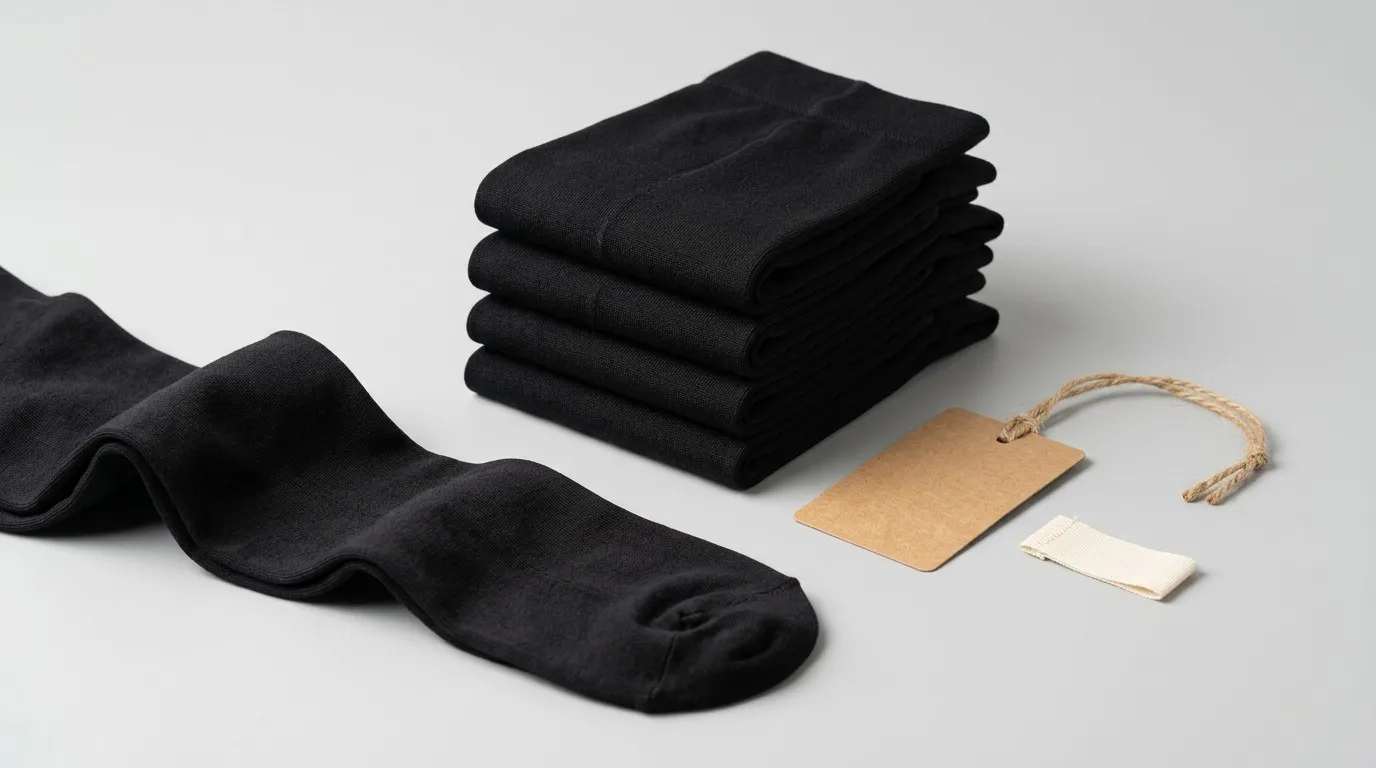
While you sacrifice design exclusivity, you gain significant agility. You can react to seasonal trends quickly because the factory already has the inventory or the ready-to-knit programs available. The primary focus here is on the "unboxing experience"—the quality of the cardstock, the printing of the logo, and the retail-ready presentation.
The Hybrid Case: ODM Base with OEM Customization
In modern hosiery manufacturing, the lines between these models often blur. A common strategy for mid-market brands is the hybrid model. You might choose an ODM base—using the factory’s proven knitting program for a specific denier—but apply OEM-level customization to the secondary components.
Examples of hybrid customization include:
- Custom Waistbands: Using an ODM leg construction but designing a custom jacquard waistband with the brand’s logo.
- Specialty Additives: Requesting that an ODM style be treated with specific finishes, such as aloe vera infusion or silver-ion anti-bacterial treatments.
- Reinforcement Specs: Increasing the durability of the toe or heel on an existing factory design.
This hybrid approach balances the reliability of factory-tested designs with the brand-building power of custom details.
Decision Guide: Which Model Should You Choose?
Choose OEM if:
- You have a patentable or unique design: You are introducing a feature that does not exist in the market.
- You are a high-volume brand: You have the scale to justify the high initial development costs and higher MOQs.
- You have an in-house design team: You can provide professional tech packs and evaluate technical samples with precision.
Choose ODM if:
- You want a professional fit without the R&D: You want to leverage the factory’s years of experience in ergonomics and material science.
- You need a faster turnaround: You need to launch a new line in months, not years.
- You require high-quality standards: You want a product that has already passed AQL 2.5 final inspections in previous production runs.
Choose Private Label if:
- You are testing a new market: You want to see if your audience will buy tights before investing in custom designs.
- Speed is your priority: You need inventory ready for a specific season or promotion.
- Your brand value is in the marketing: Your customers care more about your brand's lifestyle appeal than the specific technical novelty of the knit.
What to Put in a Tech Pack for Tights
Regardless of the model, communication is the foundation of quality. A vague brief leads to inconsistent products. A professional hosiery tech pack should include:
- Yarn Composition: Specify the percentage of Nylon 6 or 66 vs. Spandex/Elastane.
- Denier (D): The weight of the yarn, which determines transparency and warmth (e.g., 20D vs. 100D).
- Knitting Tension: Critical for ensuring the tights don't sag or pinch.
- Gusset Style: Cotton, breathable mesh, or T-band construction.
- Size Chart: Detailed measurements for length, hip width, and thigh circumference. For specialized markets, ensuring accuracy up to 8XL is a complex technical requirement.
- Dyeing Standards: Specify Pantone colors and colorfastness requirements.
- Packaging Specs: Material, dimensions, and weight of the retail box or polybag.

5 Common Mistakes Buyers Make
Even with a clear understanding of manufacturing models, many B2B buyers fall into these common traps:
- Vague Sizing Specs: "Standard size" does not exist globally. A European Large differs from a US Large. Always provide a physical measurement chart.
- Ignoring Finishing: The quality of tights is often determined in the boarding and dyeing stage. Failure to specify anti-pilling or soft-touch finishes can result in a rougher hand-feel.
- Underestimating Lead Times: Seasonal peaks can stretch factory schedules. OEM orders placed too late will miss the retail window.
- Misunderstanding AQL: Assuming "100% perfect" is unrealistic. Professional buyers use Acceptance Quality Limit (AQL) standards to define acceptable defect rates.
- Overlooking Regulations: Regions have different requirements for fiber labeling and country of origin markings. Ensure your tech pack includes these legal requirements.
Quality vs. Control: The Risk-and-Control Trade-off
A common misconception is that OEM is "high quality" and Private Label is "low quality." This is incorrect. Quality is a result of material selection and quality control processes (such as ISO 9001 and ISO 14001 certified facilities), not the manufacturing model.
The difference is control. OEM gives you the ability to innovate, but you also carry the risk of design failure. Private Label gives you no design control, but you benefit from the factory's history of successful production. It is a trade-off between uniqueness and efficiency.
Frequently Asked Questions
What is the difference between OEM and ODM tights manufacturing?
OEM (Original Equipment Manufacturing) means the factory builds a product based on your specific design and technical instructions. ODM (Original Design Manufacturing) means the factory creates the design, and you purchase it to sell under your own brand name, potentially with minor modifications.
Can I private label plus size hosiery with my own logo?
Yes. Most professional hosiery manufacturers offer a range of existing plus size molds, ranging from standard fits to 8XL. You can select these proven designs and apply your own branding, tags, and retail packaging through a private label agreement.
Who owns the knitting patterns in an ODM tights agreement?
In a standard ODM agreement, the factory owns the intellectual property and the specific knitting machine programs used to create the product. The buyer owns the trademark and brand assets applied to the product, but they generally cannot take the specific ODM knitting program to another manufacturer.
For businesses looking to secure reliable hosiery production, understanding these models is the first step toward a successful partnership. Whether you require a completely new technical design or a retail-ready branded solution, selecting the right framework ensures that your supply chain supports your broader business goals.
To discuss your specific project requirements or to see examples of our recent production runs, you can request a formal quote here.