
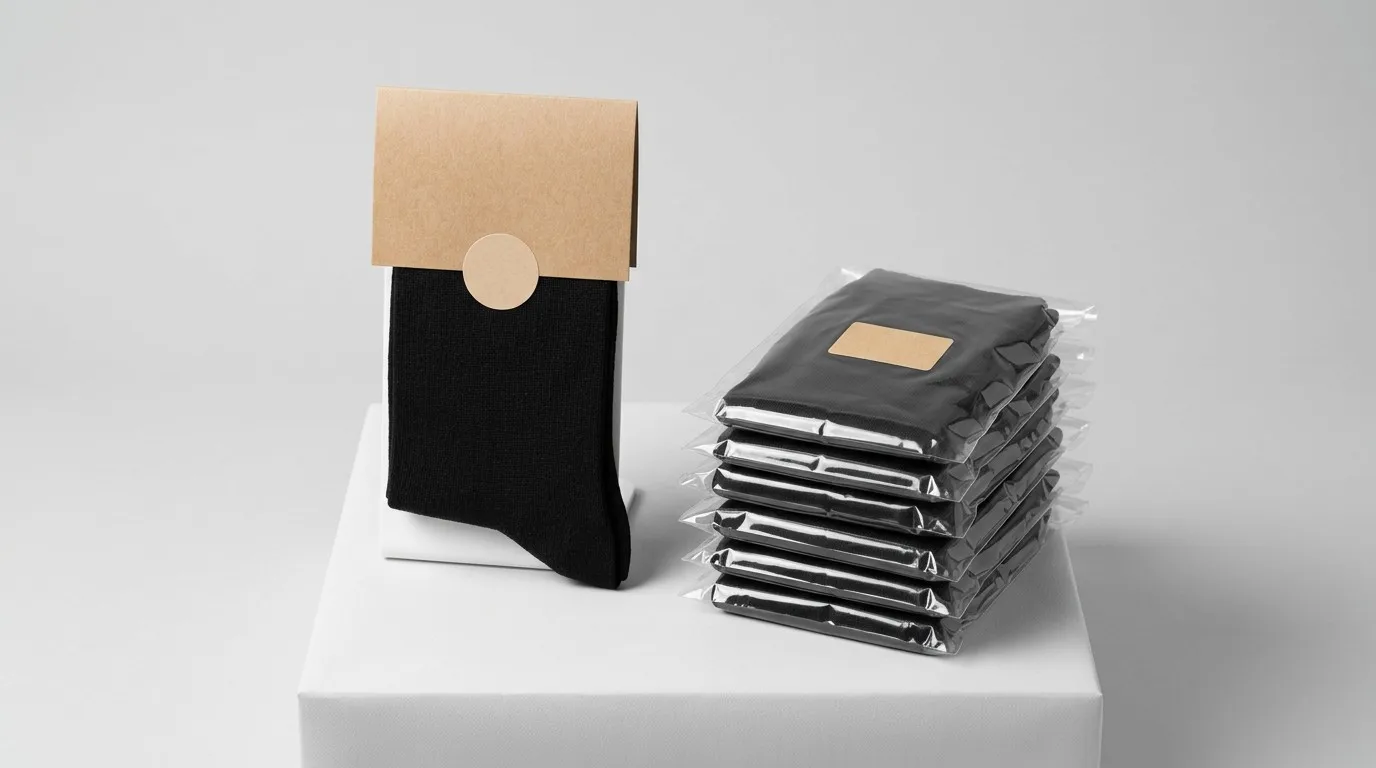
A 200 denier tight is where hosiery becomes cold-weather clothing: opaque enough to replace leggings, sturdy enough to hold its shape, and cheap enough per unit to run as volume for a retailer and as a carton staple for a distributor. The same 200D construction reaches the market in two pack formats — one built for a shelf, one built for a container. The knit is identical; cost, cube, barcodes and repacking are what differ.
What a 200D Opaque Tight Delivers — and Who Buys It
Denier measures yarn weight: 200D means 200 grams per 9,000 meters of yarn, which in hosiery signals a dense, high-coverage knit.
- Full opacity. Little light passes through, so skin tone and leg hair do not read through the fabric — the difference between a 200D opaque and the 80D semi-opaques of the shoulder seasons.
- Warmth. The density traps still air against the leg, which is where insulation comes from in an unlined tight; with a fleece lining, a 200D base becomes winter clothing rather than an accessory.
- Structure. Denser yarn resists ladders, holds its leg line after a wash, and sits flat under a skirt or boot.
Consumers buy 200D as a black winter basic, often two or three pairs at a time. Retail buyers treat it as a high-turn seasonal staple; B2B buyers — uniform, hospitality, dance and private-label brands — order it as a repeatable specification.
One Tight, Two Pack Formats
Upstream there is one product: same yarn, same machine, same boarding and dyeing. Downstream there are two finished goods that share nothing at the packing table. The retail pack is a consumer unit, presented so it can be hung or shelved with no further work by the store. The wholesale or bulk pack is a logistics unit — pairs in polybags, labeled for a distribution center rather than a shopper. Choosing the wrong one is expensive: either an over-packaged carton at the DC or a carton that must be repacked before it sells.
The Retail Pack: Built for the Shelf
- A single pair folded and sealed onto a printed hangtag or header card carrying brand, denier, size and benefit copy.
- A retail barcode — a GS1-licensed GTIN in the symbology your market expects — on the tag or polybag, readable at the register and in inventory.
- A size sticker on the outside of the pack, so one carton of assorted sizes can serve a shelf unopened.
- A hanger hole or euro-slot for a peg fixture, or a clean flat fold for a shelf tray.
- A consumer-facing fiber and care label with composition, origin and care instructions.
Every element adds material, labor and artwork management, which is why retail packs cost more per pair. For a retail-ready 200 denier example, including a plus-size fleece-lined 2-pack, see the Ladyfan 2-pack 200D plus size fleece-lined tights.
The Wholesale and Bulk Pack: Built for the Carton and the DC
- Pairs in polybags with no printed header — plain, clear or lightly printed with a small logo, sealed rather than carded.
- A batch or lot barcode on the polybag or a carton-level label, so a whole lot can be received without opening individual bags.
- Size-run cartons: solid-size for a clean intake, or assorted where the buyer wants a ready ratio. The carton label, not the pair, carries the size and quantity data.
- Minimal consumer packaging, with dimensions chosen for freight volume — carton size, pallet pattern, container utilization — rather than shelf presence.
This format supports OEM, ODM and private-label programs, because the buyer's branding is applied at the DC or on their own line. A representative bulk construction is the fleece-lined fake-translucent winter thermal leggings wholesale OEM/ODM line.
What Changes Technically Between the Two Variants
Nothing changes in the knit: denier, yarn composition, elastane content, gauge, leg length, waistband, gusset, toe linking and colorfastness are identical — the same product off the same machine.
| Stage | Retail Pack | Wholesale / Bulk Pack |
|---|---|---|
| Finishing | Boarded, folded to a card, tag attached | Boarded, flat-folded into a polybag |
| Barcode | Retail GTIN on tag or bag | Batch code on bag, carton-level label |
| Labeling | Consumer fiber and care label, size sticker | Factory ticket, carton label, pallet label |
| Carton build | Assorted sizes per carton, shelf-ready | Solid or ratio size-run cartons, DC-ready |
Because the difference is finishing rather than manufacturing, one production lot can be split between formats. Agree that split early, not at the packing stage.
Retail Pack vs Wholesale Bulk Pack: At a Glance
| Attribute | Retail Pack | Wholesale / Bulk Pack |
|---|---|---|
| Packaging | Printed hangtag or header card, sealed onto card, hanger-ready | Plain polybag, no printed header, flat-folded |
| Labeling | Consumer fiber and care label, size sticker, brand artwork | Factory ticket, batch code, master carton label |
| Barcode | Retail GTIN, shelf- and register-readable | Batch/lot barcode plus carton-level logistics label |
| Freight efficiency | Lower — card stock, hangers and larger folded dimensions consume cube | Higher — compressed polybags and dense carton packing maximize container fill |
| MOQ profile | Lower tolerance for small runs, since artwork, plates and tags are per-SKU | Higher, because carton-level programs are planned and priced around volume |
| Best use case | Department and specialty retail, e-commerce, gift and multi-pack programs | Importers, wholesalers, uniform and hospitality suppliers, private-label brands |
Labeling Requirements Differ by Market — Confirm Them Before You Print
Labeling is the most common reason a shipment is held, reworked or refused, and it is the one area where a factory cannot decide for the buyer: the obligations attach to the seller and importer of record in the destination market.
- United States — fiber content, country of origin, care instructions and the manufacturer or importer identity, permanently attached to the garment.
- Canada — the same information, bilingual in English and French.
- European Union and United Kingdom — fiber composition, care symbols, the responsible economic operator or UK importer, the required language, and packaging extended producer responsibility registration.
- Retailer overlays — tag stock, security tags, hangers, folding standards and packing slips, on top of the legal minimum.
Barcodes are licensed, not invented: the buyer supplies the GTINs and the factory prints what is approved. Lock artwork before production, because reprinting tags after a run is bagged turns a cheap component into an expensive rework.
How Pack Format Changes Freight Efficiency and Landed Cost
A carded pair is thick, stiff and often on a hanger that adds length; a polybagged pair compresses flat, so bulk packing fits more pairs into the same carton, pallet and container. Landed cost decides the format:
- Unit product cost, close to identical.
- Packaging cost, higher for retail because of card stock, plates, hangers and stickers.
- Freight, duty and handling, which favor bulk through lower cube, lower weight per pair and a lower declared transaction value.
- Downstream handling — retail packs go straight to the shelf, while bulk packs bound for retail usually need repacking and tagging at the DC — plus damage and returns, which favor carded packs.
The right format has the lowest total, not the lowest unit price. Retailers usually find the packaged unit wins; importers and private-label brands usually find bulk wins, especially when they already run their own labeling.
How to Specify Each Variant in a Tech Pack
A tech pack that does not state the pack format will be interpreted by the factory, and interpretations differ. State at minimum:
- Construction — denier, yarn composition, elastane, gauge, leg length, waistband, gusset, toe; plus graded waist, hip, thigh and foot measurements per size.
- Color and performance — color reference, colorfastness, pilling and wash shrinkage.
- Finishing — boarding method, fold standard, and whether the pair is carded, bagged or both.
- Labeling — tag artwork, stock and size, barcode symbology, placement, size sticker position, care and fiber wording.
- Packing — polybag dimensions, film thickness, ventilation, pairs per bag, carton quantity, dimensions and label format, gross weight.
- Inspection — acceptance standard and inspection point.
Labeling and packing are the entire difference between the variants, so one template with a pack-format switch beats two documents.
Merchandising and Size-Run Advice for Opaque Tights
Opaque tights behave like a basic, not a fashion item, so build depth in core sizes with a narrow color range. Black dominates in every market; charcoal, navy and dark brown are the dependable extensions.
Across the opaque tights collection, a workable retail run concentrates units in the middle sizes and keeps a genuine extended range, including plus sizes up to 8XL, available rather than special-order. In bulk, the same logic becomes a carton ratio: solid-size cartons where the DC can handle them, assorted cartons where the customer wants a shelf-ready mix. Multi-packs raise order value and cut packing cost, but only when the sticker and barcode describe the pack.
A Buyer's Decision Checklist
- Which pack format each destination requires — retail shelf, e-commerce or DC intake.
- Who supplies the GTINs, and in which symbology.
- The destination market's fiber, care, origin and importer labeling rules, in writing.
- Whether artwork is locked before production starts, and the size run, carton ratio and carton dimensions, with gross weight.
- Whether the bulk allocation will be repacked downstream, and what that costs in labor and time.
- The landed cost comparison across both formats, not just the FOB unit price.

Frequently Asked Questions
Are 200D tights warm enough for winter?
For most cold-weather use, yes. A 200 denier opaque traps a layer of air and is the standard winter weight in many markets. Where it is colder still, a 200D fleece-lined construction adds insulation without changing the outer appearance.
What is the difference between retail pack and bulk pack tights?
The tight itself is identical. A retail pack adds a printed hangtag or header card, a retail barcode, a size sticker and consumer-facing care and fiber labels, so the pair goes straight onto a shelf. A bulk pack uses a plain polybag, a batch or carton barcode and size-run cartons, so goods ship and are received efficiently, with branding applied later by the buyer.
What is the minimum order quantity for custom 200D opaque tights?
MOQ depends on the variant and the level of customization. Bulk programs start lower because they carry less artwork and fewer packaging components; fully custom retail packs — bespoke header cards, retailer-specific labels, private-label branding — usually need larger runs, since plates and tag production are per-SKU costs. Extended sizes and special colors move the threshold too, so share your pack format, size run and market for a quotation.
Once your pack format, size run and target market are defined, the next step is a specification review and quotation. Send the details through the request for quote page and you will get a response built around the retail or bulk configuration you actually need, rather than a generic price list.