
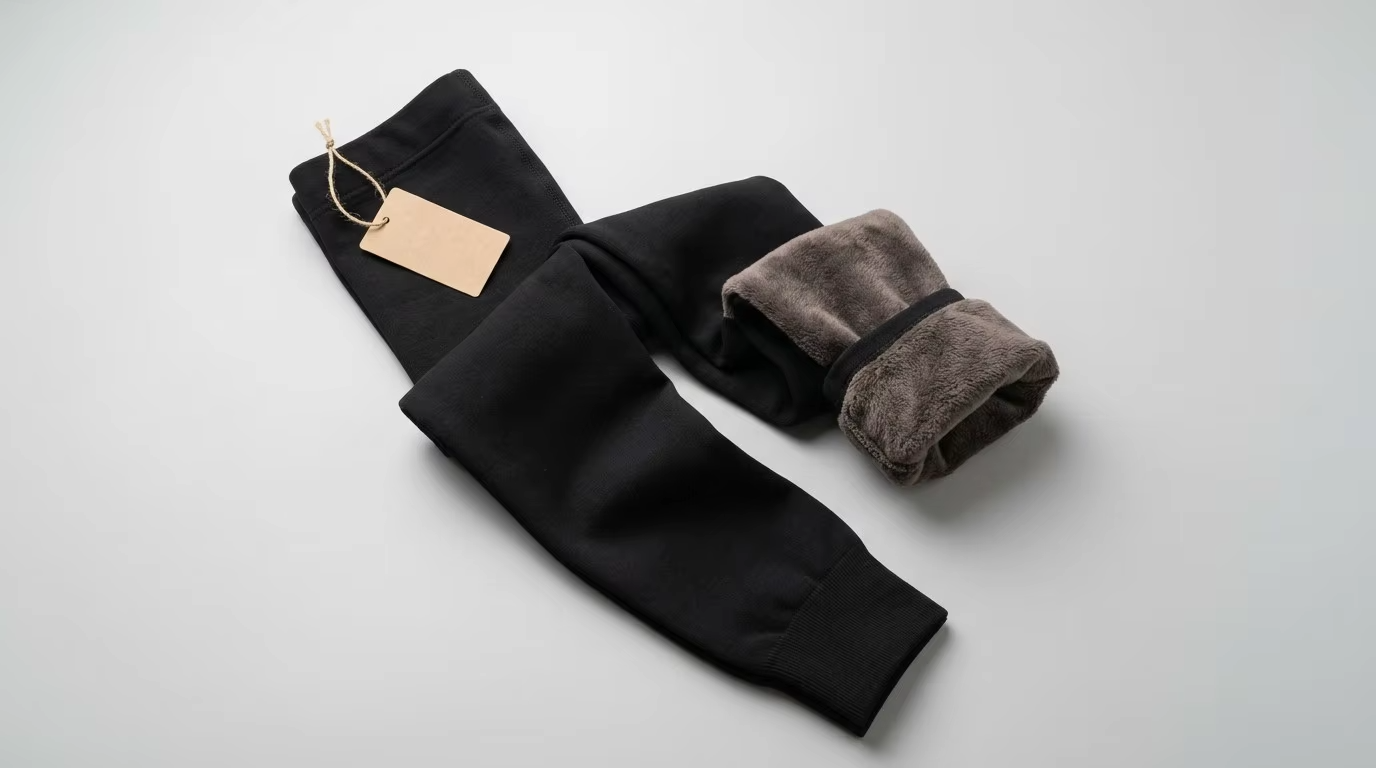

Winter hosiery sits between two expectations that rarely align: the consumer who wants warmth on the first cold morning, and the buyer who needs the product to survive a season on the fixture without returns or dead stock. In between sits a detail that is widely misunderstood and badly specified — what "fleece-lined" actually means in a knitted legwear garment.
Dongyang Jiban Apparel Co., Ltd. manufactures pantyhose and tights in Jinhua, Zhejiang. Founded in 2022 and certified to ISO 9001 and ISO 14001, the factory runs OEM, ODM and private label programs from 10D to 200D, including plus sizes to 8XL.
What "Fleece-Lined" Actually Means in Hosiery
The phrase implies a knitted shell with a separate fleece layer stitched inside. In hosiery, that construction essentially does not exist. What the term describes is a brushed, lofted inner face.
The leg panel is knitted normally, then passed over rotating carding rollers fitted with fine wire points, which catch individual fiber ends and raise a nap on one face of the fabric. The result is a one-piece knit whose inner surface traps air against the skin.
Two routes are common: a single knit using a heavier inner yarn that brushes up readily, or a plated structure with a smooth fine-gauge yarn on the outer face and a lofted acrylic or microfiber yarn on the inner face. Because warmth comes from trapped air rather than a laminated layer, brushing depth and fiber blend matter more than the word "fleece" on the label.
Brushed, Fleece-Lined, Plush and Fake-Translucent Compared
Four constructions are sold as winter legwear and they are not interchangeable. A brushed interior is a standard 80D–200D opaque with a lightly brushed inner face: shallow nap, normal stretch, low bulk, modest warmth gain. A fleece-lined build uses a heavier inner yarn brushed to a pronounced loft — the warmest single-garment option and the bulkiest. Plush means a deeper pile made with higher acrylic content and a longer brush cycle; it feels softest and flattens most noticeably in storage.
| Lining type | Relative warmth | Bulk / packed volume | Cost position | Best use |
|---|---|---|---|---|
| Brushed interior | Low to moderate | Low | Lowest | Transitional seasons, layering under trousers, a thermal claim on a standard opaque fit |
| Fleece-lined | High | High | Moderate | Core winter SKUs, cold-climate markets, everyday warmth |
| Plush / lofted | High, softer hand | High to very high | Moderate to high | Premium and gift sets, private label hero styles, comfort positioning |
| Fake-translucent | Moderate | Low to moderate | Highest per pair | Styling-led winter ranges where consumers want a sheer look with warmth |
Warmth Ratings: The Gram-Weight and Loft Question
Denier measures yarn density, not warmth. A 200D thermal tight is not automatically twice as warm as a 100D, and a "500D" claim on packaging frequently refers to total yarn consumption rather than face yarn weight.
Warmth in a brushed knit is driven by finished panel weight, the loft of the raised inner face and air permeability. Winter thermal leg panels commonly fall into a fabric weight band of roughly 220–400 gsm with a loft of roughly 1.5–4 mm, measured on a relaxed finished panel. Those are industry-typical reference bands to confirm with your supplier, not a specification for any one factory.
Write the test method and conditioning into the tech pack, including whether the panel is washed at the care temperature before measuring, since brushed acrylic can change thickness after the first wash. A signed reference sample defines "warm" more reliably than a hangtag figure.
Footed vs Footless Thermal Options
Footed thermal tights keep the full insulation envelope from waist to toe and match how consumers already wear tights. The challenge is the foot: a deep nap bunched inside a closed shoe is uncomfortable and shortens the apparent leg. The usual answer is to reduce or omit brushing on the foot panel while keeping the leg lofted, and to reinforce the sole and toe.
Footless thermal leggings remove the footwear problem and extend the product beyond the hosiery fixture — they layer under trousers and work with boots and socks. The trade-off is category placement: a footless garment reads as legwear or activewear rather than hosiery, which changes where it is merchandised and priced.
The Fake-Translucent Construction
Fake-translucent solves a styling problem as much as a temperature one: consumers want the polished look of sheer black or sheer nude in winter, while conventional sheers offer no warmth at all.
The construction places a fine-gauge face yarn — typically 40D–80D by appearance — over a lofted, brushed inner face. Because the face knit is fine, light passing through it picks up a hint of skin tone or of the lighter inner yarn beneath, so the leg reads as semi-sheer while the wearer is insulated. A related effect uses a dark semi-sheer face over a lighter brushed interior, letting the contrast create the illusion.
This is the highest-value positioning of the four builds and the least forgiving: face and inner yarns must match in stretch behavior or the surface shades unevenly over knee and shin, and lot-to-lot variation in face yarn brightness shows immediately. Review production-lot shading against a signed standard, not the development sample alone. These fleece-lined thermal tights in the fake-translucent build can be produced in footed or footless versions from one base specification.
Sizing and Stretch Behavior With Bulkier Linings
Adding a brushed inner face changes how a garment stretches, and that is where most thermal programs go wrong. The nap acts as a friction layer against the skin, increasing the force needed to pull the tight up the leg, and the extra yarn reduces elongation at a given circumference, so a pattern that fits at 80D feels tighter once brushed to winter loft. The effect compounds in larger sizes and shows first at the waistband, knee and ankle.
- Graduated loft. Brush the thigh and seat more heavily and taper toward the ankle and knee, keeping warmth where it matters without losing articulation.
- Height-anchored sizing. Because loft consumes vertical stretch, a chart built on height and hip is more reliable than weight alone. Reference a known standard such as these 200D plus size fleece-lined tights.
- Recovery testing. Measure elongation at a defined load, then growth after 30 minutes of wear and after five launderings.
- Fit trials. At least three testers per size band, including tall and plus-size wearers, before bulk approval.
Above 6XL, loft should generally reduce as the size climbs; full loft at the top of the range is warm but hard to put on, and difficulty dressing is a leading cause of thermal hosiery returns.
What Retail Buyers Should Check Before Stocking
Retail buyers face four risks that do not exist in fashion sheers.
Shelf life and compression. A lofted acrylic lining flattens when packed tightly or stored too long. Ask how the garment is folded, whether an insert or hanger is used, and what recovery time is expected after unpacking.
Packaging volume. A thermal tight is the bulkiest item in the hosiery set. Packed volume per pair can run roughly two to three times that of a standard 40D opaque, which changes carton cube and fixture density. Work out planogram space per SKU, not per pair; a bag-and-header or two-pack format often yields more units per square meter than a rigid box.
Size runs. Thermal sells on a different curve than fashion sheers: fewer small sizes, more mid and large. An assortment copied from a sheer size run sells out at the large end and marks down at the small end.
Returns risk. The main drivers are warmth expectation mismatch, waist roll-down, bulk inside shoes and first-wash shrinkage. Each is manageable with accurate packaging copy, a clear care label, a tested size chart and a pre-shrunk specification.
What Wholesale and OEM Buyers Should Specify
A tech pack for a winter tight should define, at minimum: lining type, meaning single-face brushed or plated double-layer; target panel weight and loft with the test method named; denier targets stated separately for face and inner yarn, plus a definition of what any marketing denier figure refers to; inseam, rise, waistband depth and whether the gusset is cotton-lined; packaging, including size sticker, barcode or EAN, care label languages and master carton cube; and testing, covering AQL 2.5 final inspection plus lab work on pilling, colorfastness, dimensional stability and fiber composition. Note that ISO 9001 and ISO 14001 certify a factory's management systems, not the product. Retain a signed sealed sample at proto, fit and pre-production stages; the sequence is set out in our B2B order process and delivery showcase.
Treat any commercial figure as a quotation specific to that factory and that moment. Thermal programs generally carry higher minimums than fashion sheers, because extra yarn and slower knitting raise the cost of a short run. Sampling fees and lead times for a winter program commonly run longer than for a basic opaque, and both move with the acrylic yarn market. Confirm every number against the supplier's current quotation.
Seasonal Timing
Winter hosiery reaches shelves between September and November in the northern hemisphere, so sourcing decisions are made six to nine months earlier. A workable default calendar runs roughly: development and sample approval in the first quarter, bulk production in the second, shipping in the third, on-shelf placement in the fourth. Programs also have to clear the Chinese New Year window, when factory capacity contracts sharply for weeks.
Counter-seasonal markets — Australia, New Zealand, parts of South America — invert the schedule and buy for a June-to-August winter, letting one development season feed two selling seasons. Acrylic yarn pricing also tightens as the northern heating season approaches.
Care Instructions That Preserve the Lining
The brushed inner face degrades fastest, and almost all of that degradation comes from heat, friction and fabric softener.
- Wash at 30°C / 85°F on delicate, or by hand. Hot water plus mechanical action is what pills and mats a brushed nap.
- Use a fine-mesh laundry bag so the raised face is not rubbed against zippers and heavier garments.
- Skip fabric softener; it coats the fiber, collapses the loft and reduces moisture management.
- No bleach or optical brighteners, particularly on black and navy.
- Never tumble dry. Line dry flat in the shade; heat is the main cause of elastane loss and shrinkage.
- Store folded rather than compressed, and avoid long-term vacuum packing.
Expect light shedding for the first two or three washes; it is normal for a brushed knit and stops once surface fibers are gone.

FAQ
Are fleece-lined tights warmer than 200D tights?
Usually, but not because of the denier figure. A 200D label describes yarn density, not warmth; a fleece-lined tight is warmer because its brushed inner face traps air next to the skin. Two garments both sold as fleece-lined can also differ depending on panel weight and loft, so compare a signed reference sample rather than the number on the pack.
Do fleece-lined tights run true to size?
Often they fit tighter than the equivalent opaque, because the brushed inner face adds friction and reduces available stretch. Treat a thermal size chart as height-and-hip based, size up when the wearer is between two sizes, and check how loft changes across the run. Excessive loft at the largest sizes is a common cause of difficulty dressing and of returns.
How do you wash fleece-lined tights without ruining the lining?
Wash cold — around 30°C / 85°F — on a delicate cycle in a mesh bag, skip fabric softener, and never tumble dry. Line dry flat and away from direct heat; those four rules keep the nap lofted and the elastane intact.
If you are building a winter thermal program and want specification, sampling and inspection criteria mapped to your own size range, request a quote and the team will work from your tech pack — or help you build one — against the full wholesale tights range of 10D to 200D constructions.