
For B2B buyers, retail category managers, and private label brand owners, understanding the cost structure of hosiery manufacturing is critical for maintaining margins and ensuring product quality. Hosiery production is a high-precision, capital-intensive industry where small technical variations lead to significant differences in unit price. Unlike simpler garments, a pair of tights is a complex technical assembly of polymers, precision engineering, and chemical processing.
Dongyang Jiban Apparel Co., Ltd., based in Jinhua, Zhejiang, has observed the evolution of the global hosiery market since its founding in 2022. Operating under ISO 9001 and ISO 14001 certifications, the factory environment in China’s textile hubs like Jinhua provides a clear window into how manufacturing costs are calculated for the international market. This guide provides a transparent breakdown of the variables that determine the final landed cost of wholesale hosiery.
The Raw Material Layer: Yarn Choice and Denier
The most fundamental driver of cost in hosiery is the yarn. Most modern tights are constructed from a blend of Nylon (Polyamide) and Elastane (Spandex). However, not all yarns are created equal.
Nylon 6 vs. Nylon 6.6
In the global market, manufacturers typically choose between Nylon 6 and Nylon 6.6. Nylon 6.6 is the premium option, offering a softer hand-feel, better color fastness, and higher heat resistance. Because the molecular structure of 6.6 is more stable, it often commands a 15% to 30% price premium over standard Nylon 6. For brands positioning themselves in the luxury or high-performance segment, the investment in Nylon 6.6 is often non-negotiable.
Denier and Dtex
Denier (D) is the unit of measurement for the weight and thickness of the yarn. Specifically, it represents the mass in grams per 9,000 meters of fiber. A 10D yarn is exceptionally fine, while a 200D yarn is thick and heavy.
- Low Denier (10D–20D): These ultra-sheer tights require high-precision handling. While they use less raw material by weight, the yarn is more expensive to extrude and more prone to breakage during knitting, which can increase the defect rate.
- High Denier (80D–200D): These opaque tights use significantly more polymer. The cost here is driven by the volume of raw material consumed.
Covered vs. Bare Elastane
The way elastane is integrated into the nylon determines durability and stretch recovery.
- Bare Elastane: The cheapest method. The spandex is knitted directly alongside the nylon. It is less durable and has a harsher feel.
- Single Covered Yarn (SCY): The nylon is wrapped around the elastane core once. This is the industry standard for mid-market hosiery.
- Double Covered Yarn (DCY): The elastane is wrapped twice in opposite directions. This provides maximum durability and a luxurious, matte finish but significantly increases the material cost and the time required for yarn preparation.
Knitting Costs: Machines, Gauge, and Time
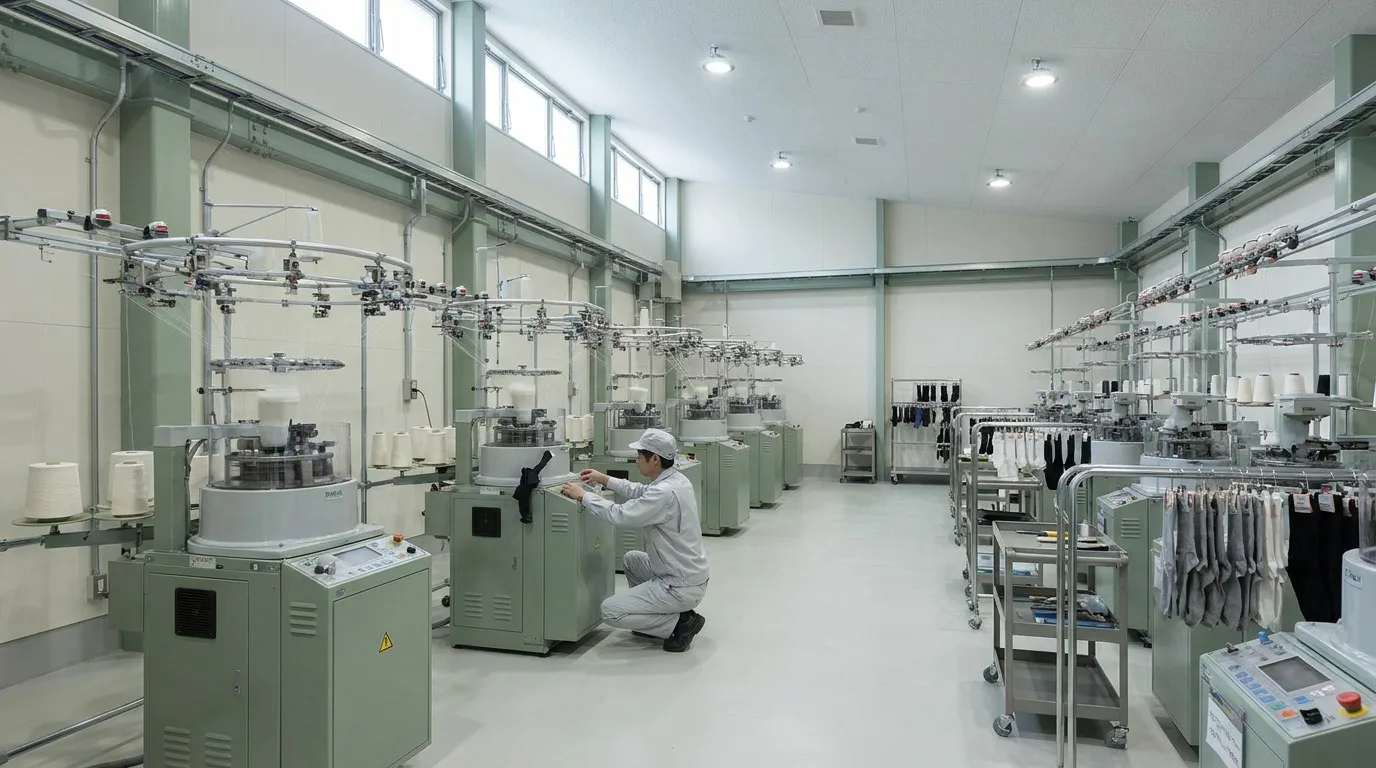
Once materials are selected, the knitting process begins. This stage is governed by the technical specifications of the circular knitting machines.
Machine Gauge and Needle Count
The "gauge" refers to the number of needles per inch. A higher needle count (e.g., 400 needles) creates a finer, denser fabric. High-gauge machines are more expensive to purchase and maintain. Furthermore, knitting a fine-gauge sheer tight takes longer than knitting a coarse-gauge thick tight because the machine must complete more revolutions to achieve the same length.
Circular vs. Flat Knitting
Most standard tights are produced on circular knitting machines, which create a seamless tube. This is highly efficient for mass production. However, specialized items, such as certain medical-grade compression hosiery or complex lace patterns, may require different machinery configurations, which can double or triple the knitting cost per unit due to slower cycle times.
Dyeing, Colorfastness, and Chemical Finishing
Hosiery comes off the knitting machine in a "greige" state—an off-white, raw tube. The transformation into a finished product occurs in the dye house.
Dye Lot Minimums
Dyeing is a batch process. A standard industrial dyeing machine might have a minimum capacity of 100kg to 500kg of fabric. If a buyer requests a custom color that does not meet the minimum weight of a dye lot, the manufacturer must charge a "surcharge" to cover the wasted capacity and chemicals. This is why standard colors like black and nude are always more cost-effective.
Boarding and Heat-Setting
Boarding is the process of pulling the tights over a metal leg form and subjecting them to high-pressure steam. This sets the shape, ensures consistent sizing, and gives the fabric its final "memory." Precision boarding is essential for plus-size tights (which Dongyang Jiban produces up to 8XL) to ensure the stretch dimensions are maintained after the consumer puts them on. Lower-cost manufacturers may skip or rush this step, leading to inconsistent sizing.
Construction and Assembly: The Human Element
While knitting is automated, assembly often requires manual labor. The method of seaming significantly impacts the "hand" of the garment and its cost.
- Standard Seaming: A basic overlock stitch used to join the toes and the panty section. It is fast and inexpensive but creates a visible ridge.
- Flat Seaming: A more advanced four-needle, six-thread stitch that lies flat against the skin. This is preferred for high-end activewear and premium hosiery.
- Hand-Linking: The most expensive method, where a worker manually aligns the stitches of the toe to create a truly seamless finish. This is rare in mass-market tights and usually reserved for luxury hosiery.
- Gussets: The addition of a cotton or breathable synthetic gusset in the crotch area adds both material cost and a secondary sewing operation.
Anti-Snag Finishing and Specialized Treatments
To add value, many brands request functional finishes. These are applied during or after the dyeing process:
- Silicone Softeners: For a silk-like touch.
- Anti-Static Agents: To prevent the tights from clinging to skirts.
- Antibacterial/Anti-Odor Treatments: Silver ion or zinc-based finishes for hygiene.
- Run-Resist (Ladder-Proof) Technology: Often involving a specific "lock-stitch" knitting pattern that prevents a small hole from turning into a long run. This requires specialized machine settings and often uses more yarn.
Packaging, Labeling, and Retail Readiness
For many B2B buyers, the "unit" is not just the tights, but the finished retail package.
- Polybag vs. Box: Simple polybags with a cardboard header are the most economical. Rigid cardstock boxes with UV coating or foil stamping are significantly more expensive and increase shipping volume.
- UPC and Labelling: Applying individual UPC stickers, price tags, or RFID tags adds labor and material costs.
- Sustainability: Recycled paper inserts and biodegradable polybags are growing in popularity but typically carry a 5% to 10% premium over virgin plastic and paper.
Quality Control: AQL 2.5 Standards
Quality assurance is not free. A factory that operates under ISO 9001, like Dongyang Jiban, integrates inspection at multiple stages:
- Initial Inspection: Checking the greige tubes for knitting defects (dropped stitches, oil spots).
- In-Process Inspection: Monitoring dye consistency and seaming strength.
- Final Inspection: Typically performed to AQL (Acceptable Quality Limit) 2.5 standards. This means a statistically significant sample of the finished batch is checked for defects. Higher levels of inspection (e.g., 100% inspection) significantly increase the labor cost per pair.
Freight, Duties, and Logistics
The manufacturing cost is only part of the equation. B2B buyers must account for the "landed" cost.
- Volume vs. Weight: Tights are lightweight but high-volume when boxed. Shipping 10,000 pairs of sheer tights in polybags is far cheaper than shipping 10,000 pairs of 200D fleece-lined tights in rigid boxes.
- Incoterms: Costs will vary depending on whether the quote is FOB (Free on Board), where the buyer handles shipping from the port, or DDP (Delivered Duty Paid), where the manufacturer handles everything.
- Import Duties: Hosiery often faces specific tariff classifications. Buyers should consult their local customs schedules to understand the tax implications of nylon-heavy vs. cotton-heavy blends.
Cost Comparison Table by Denier and Tier
| Product Category | Denier Range | Primary Material | Knitting Complexity | Relative Cost Position |
|---|---|---|---|---|
| Ultra-Sheer | 10D – 15D | Nylon 6.6 + Bare Spandex | High (Precision) | Medium |
| Standard Sheer | 20D | Nylon 6 + SCY Spandex | Moderate | Low |
| Semi-Opaque | 30D – 40D | Nylon 6 + SCY Spandex | Moderate | Medium |
| Standard Opaque | 80D – 120D | Nylon 6 + DCY Spandex | Low (Volume) | Medium-High |
| Winter/Fleece | 200D+ | Polyester/Nylon Blend | High (Double Layer) | High |
Note: This table reflects typical market observations and relative positioning rather than specific factory pricing.
Economies of Scale: Why Volume Matters
The unit price of hosiery is highly sensitive to order volume. This is due to three main factors:
- Machine Setup: Every time a machine is switched from a 20D sheer to an 80D opaque, it must be re-threaded and calibrated. This "downtime" is a fixed cost amortized over the production run.
- Yarn MOQs: Yarn suppliers have their own minimums. Buying 50kg of a specialty yarn is much more expensive per kilogram than buying 5,000kg.
- Dye Lot Efficiency: As mentioned, filling a dyeing machine to its maximum capacity minimizes the cost of water, electricity, and labor per unit.
Sample Costs and Prototyping
For private label buyers, the process begins with samples. Developing a new style involves:
- Programming Fee: A technician must program the knitting machine's pattern.
- Courier Fees: Sending samples back and forth between China and the buyer's office via DHL or FedEx.
- Material Sourcing: If a specific non-stock yarn is required, the factory may have to purchase a minimum quantity just for a few pairs of samples.
Most factories charge a flat fee for samples, which may be credited back upon a bulk order.
How to Read a Hosiery Quotation
When you receive a quote for a broad range of wholesale tights, ensure the following details are explicitly listed:
- Material Composition: Detailed percentage of Nylon vs. Elastane (e.g., 85% Polyamide, 15% Spandex).
- Yarn Type: Specify if it is SCY, DCY, or Bare Spandex.
- Weight per Pair: Crucial for calculating shipping and verifying material density.
- Packaging Specs: Dimensions, paper weight (GSM), and finish.
- Incoterms: FOB Ningbo/Shanghai is common for Jinhua-based factories.
- Compliance: Certifications such as OEKO-TEX Standard 100 or ISO 9001/14001.
FAQ
How much does it cost to make a pair of tights?
The manufacturing cost is highly variable and depends on the yarn quality (Nylon 6 vs 6.6), the denier (10D to 200D), and the construction complexity (standard vs. flat seams). Market prices are determined by raw material costs, labor for assembly, and the scale of the production run.
What is the MOQ for private label hosiery?
Typical market MOQs for custom-dyed hosiery range from 2,000 to 5,000 pairs per color/size. This minimum is usually driven by the capacity of industrial dyeing vats and the minimum order quantities set by yarn extruders.
Why are some tights more expensive than others?
Price differences usually stem from the yarn wrapping technique (Double Covered Yarn is more expensive than Bare Spandex), the machine gauge (finer knits take longer), and the finishing processes like heat-boarding and hand-linking, which improve fit and durability.
Understanding these variables allows buyers to make informed decisions that balance price with consumer expectations. By focusing on technical transparency, brands can build a sustainable supply chain that delivers quality at every price point.
If you are looking to develop a new hosiery line or optimize your current production, you can request a detailed manufacturing quote to receive a breakdown based on your specific requirements.